Text to Game AI Platform: What You Get, and What You Still Have to Do
What a text to game AI platform actually does, what an H5 build can and cannot deliver, where the description stops being enough, and how to get a first version shareable tonight.

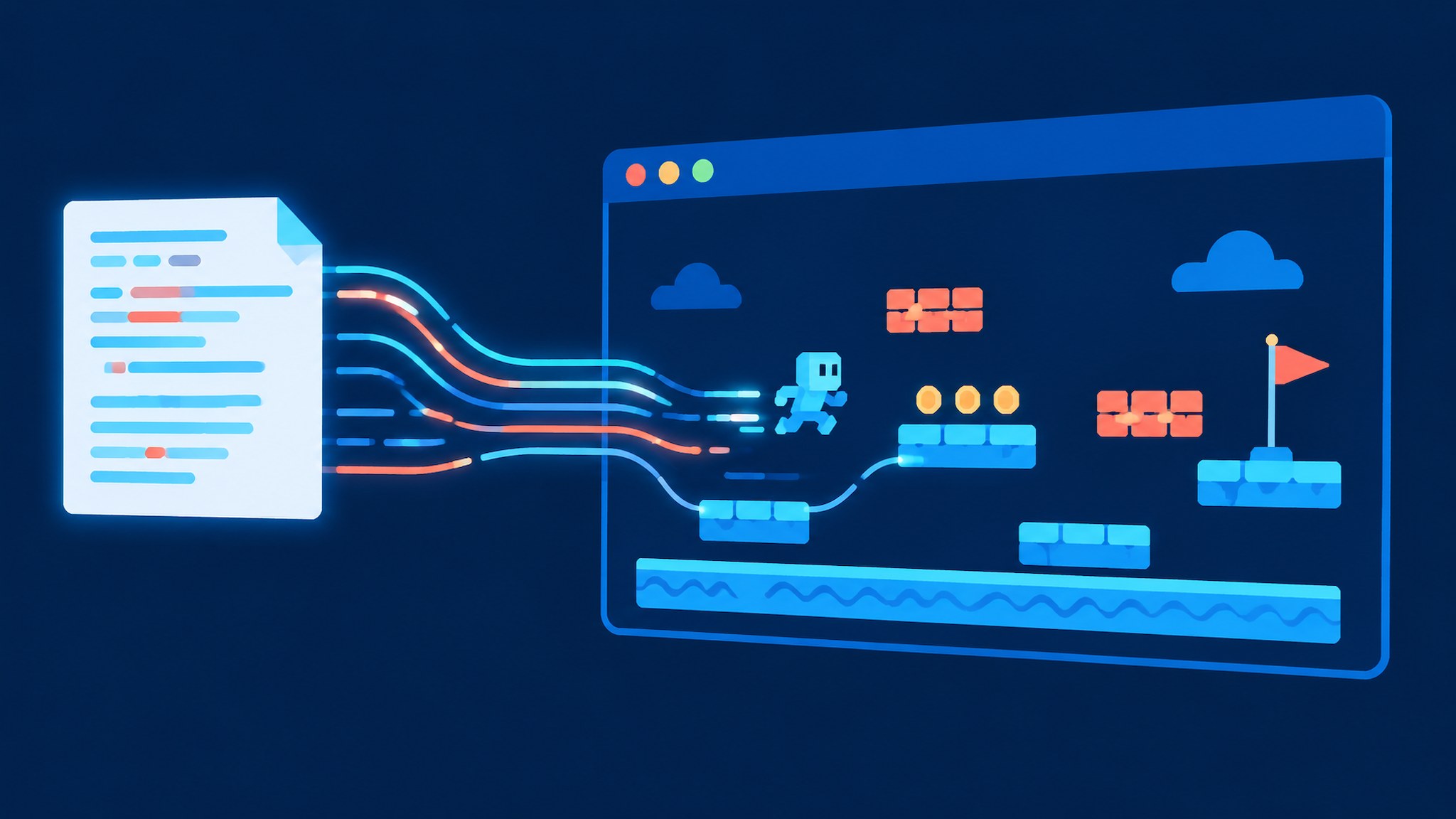
A text to game ai platform collapses the distance between a sentence and something you can play. You write what happens on screen. The platform decides the rules that make it happen, draws the pieces, and returns a build that opens in a browser tab. No scene editor, no script file, no asset folder to keep track of. The trade is real: you get a running game instead of a project you own line by line, and every revision goes back through the sentence.
This piece covers what that loop actually produces, what an H5 build can carry, where the description stops being a sufficient design document, and how to get a first version in front of other people in a single evening. It's written for someone who has an idea and no art skills, and who would rather learn the shape of the workflow before picking a tool.
What a text to game ai platform actually hands you
The output is a playable artifact, not a source tree. Concretely, you end up with a ruleset the platform inferred, a set of generated visuals, a soundtrack or sound effects, and a wrapper that makes the whole thing run in a web page. What you don't get is a scene graph you can rearrange by hand, a scripting layer where you write conditional logic, or a diff view that tells you what changed between two versions.
That distinction decides a lot downstream. In an engine, the project file is the truth and the build is a byproduct. Here the sentence is the truth and everything else is a byproduct, including the game you just played. Two people running the same workflow with the same paragraph get builds that satisfy the paragraph and differ in everything the paragraph left open.
BinkBink works on this model: a written description goes in, a browser-playable build comes out, and the build can be shared as a link. The interesting part isn't that it works. It's what the sentence has to contain for the result to be worth keeping.
One paragraph in, one playable build out
The pipeline behind the sentence has a few visible stages even if you never see them. An ai game generator reads the description and extracts entities: what the player controls, what obstructs it, what counts as a win, what counts as a loss. It maps those to an input scheme, usually one or two gestures, because a short browser session can't teach five controls. It then picks a pacing curve, generates the visual pieces that match the setting you described, and assembles everything into a bundle a browser can load.
Two consequences follow from how that works.
The first is that specificity beats enthusiasm by a wide margin. "A fun platformer" leaves every decision open, so the platform fills the gaps with defaults that are reasonable and forgettable. "A courier robot crossing three conveyor belts, speed rising every twenty seconds, one wrong step ends the run" closes the opening, the failure state, and the difficulty curve at once. The second paragraph is shorter than most design briefs and does more work, because each clause removes a decision.
The second consequence is that output isn't deterministic. Ask twice, get two builds that both satisfy the description and neither of which matches the picture in your head exactly. That's not a defect to file. It's the reason you keep the paragraph as the artifact you version, and treat every build as a draft of it. When a change improves the game, the sentence should change too, or the improvement disappears on the next generation.
An h5 game generator buys distribution, not ambition
H5 here means the game runs in a browser: no install, no store review, no platform approval, a link that opens on a phone and on a laptop with the same build. Distribution is the real gain. You can put a playable game in a chat message, in a post, in a support thread, in a document. That's a lower bar than shipping an app, and for a prototype it's the difference between feedback and no feedback.
The cost sits underneath. A browser gives you a fixed budget: one process handling logic and rendering, a WebGL context that has to fit in memory alongside the page, an asset payload that has to arrive before the first frame is playable. On a mid-range phone that budget runs out fast. Large 3D scenes, dense particle effects, many animated characters on screen at once, and anything resembling real-time multiplayer all press against it.
So the genre fit isn't a matter of taste, it's arithmetic. Short-session games with a small number of visible objects and a clear loop land comfortably: endless runners, arcade survival, simple puzzles, merge boards, branching text with a few illustrations. Games that need a persistent world, synchronized players, or hundreds of simulated units don't land comfortably, and no amount of prompt craft moves that ceiling.
Where the description stops carrying the project
Four things reliably escape a paragraph, and knowing them saves weeks.
Ambiguity is the first. Adjectives such as fun, polished, satisfying, or immersive describe a feeling, and a feeling can't be executed. A platform can only act on conditions it can evaluate: what the player presses, what happens on contact, when the run ends, how fast things move. If a clause can't be turned into a check, it doesn't survive the translation.
Interaction precision is the second. Frame-level feel, the exact arc of a jump, the recovery window after a hit, the acceleration curve of a dash, are tuned by adjusting numbers against a build you can replay in milliseconds. Here you tune by rewriting the clause and regenerating, which is coarse. You can move the jump from floaty to heavy. You can't dial in the eleven frames of coyote time that make a platformer feel fair.
State complexity is the third. A rule like "if the player has the key and the door is unlocked" is easy. A rule like "the shop restocks on the third day, prices scale with reputation, and rare items only appear after the second boss" is a system, and systems need explicit state, ordering, and persistence. Descriptions carry a loop well and a simulation badly.
Content volume is the fourth. Generating one screen is cheap. Generating twenty levels that escalate without repeating is a content pipeline problem. If your game needs a campaign, the sentence becomes a table of contents, and you're back to authoring by hand with a generator assisting.
Why does a browser build feel so different from an engine project, then? Because the artifact is a URL. Persistence, accounts, leaderboards across devices, and anything that survives a cleared cache require a backend, and a description-driven build doesn't come with one.
Getting a first build shareable in one evening
The fastest path to something real is to shrink the scope until the workflow itself is the only variable. Do this in one sitting.
- Write three sentences in a plain text file: what the player does every ten seconds, what ends the run, and what makes it harder over time. Keep them under forty words total.
- Generate from those three sentences. Don't add a fourth.
- Play for five minutes and pick exactly one defect. The one that made you stop, not the one that looks worst in a screenshot.
- Rewrite the clause responsible, regenerate, and play again. If the defect survived the rewrite, the clause wasn't the cause, and the cause is the loop itself.
- Send the link to three people who haven't read your sentences. Ask one question: where did you stop wanting to continue. Don't ask whether they liked it.
Step four is where most first sessions go wrong. Two or three clauses get changed at once, the build improves, and nobody learns which change did it. One clause per round keeps the cause attached to the effect, and it keeps the round short enough to run five of them in an evening.
Who shouldn't start with a text to game ai platform
Anyone whose game depends on precise physical feel should start in an engine. The tuning loop is the product there, and a description can't substitute for a slider you drag while watching the result.
Anyone whose idea is a world rather than a loop should also pause. Lore, characters, factions, and maps can absorb months of writing while the playable core stays undefined. A platform will cheerfully generate something that matches the setting and has nothing to do twice. Which is the failure mode nobody warns you about.
Teams that need code ownership are a third case. If the work has to be reviewed, diffed, extended by another developer, or kept alive for years, the artifact has to be a project, not a generated build.
And anyone whose design requires accounts, economies, or live multiplayer should treat the description-driven route as a prototyping step rather than a delivery route, because the missing backend is structural, not cosmetic.
Four checks before you give it a month
Before committing serious time, run four checks against the build you already have.
Can you play the core loop three times in a row without being bored? That question tests the loop, not the polish, and it's the one that predicts whether the project is worth the next month.
Can you name the single variable you would change next? If the answer is vague, the design is still a mood, and more generation won't fix it.
Can the result be shared in a form your players can open without instructions? A build nobody can open is a private experiment, and private experiments don't generate the feedback that makes the next version better.
Is the scope still one screen? The moment the honest answer becomes "one screen plus a map plus a shop", the workflow that got you here stops being the right one, and the decision to move to a tool with explicit state is overdue rather than premature.
The paragraph is the design document. Keep it short enough to reread in ten seconds, and specific enough that a stranger could implement it without asking you a question. Everything else the platform can carry.