Paper.io 2 Review: The Risk Is Real, the Reward Is Thin
A Paper.io 2 review of what expansion really costs, the three deaths that end most runs, and who should bother with the free download.

Paper.io 2 is the best five-minute game in the whole .io game scene, and it would be a small classic if it let you leave at five minutes. It doesn't. The rule takes one sentence to explain, which is why your first round feels like a magic trick, and the app spends the next forty minutes billing you for it.
I've played it on and off since 2018, maybe fifteen hours in total, nearly all of it in short phone sessions with one thumb. That's the shape the game is built for. It's also the shape it keeps trying to break.
Below: what expansion costs, the three deaths that end most runs, and a verdict.
What Paper.io 2 Gets Right in the First Thirty Seconds
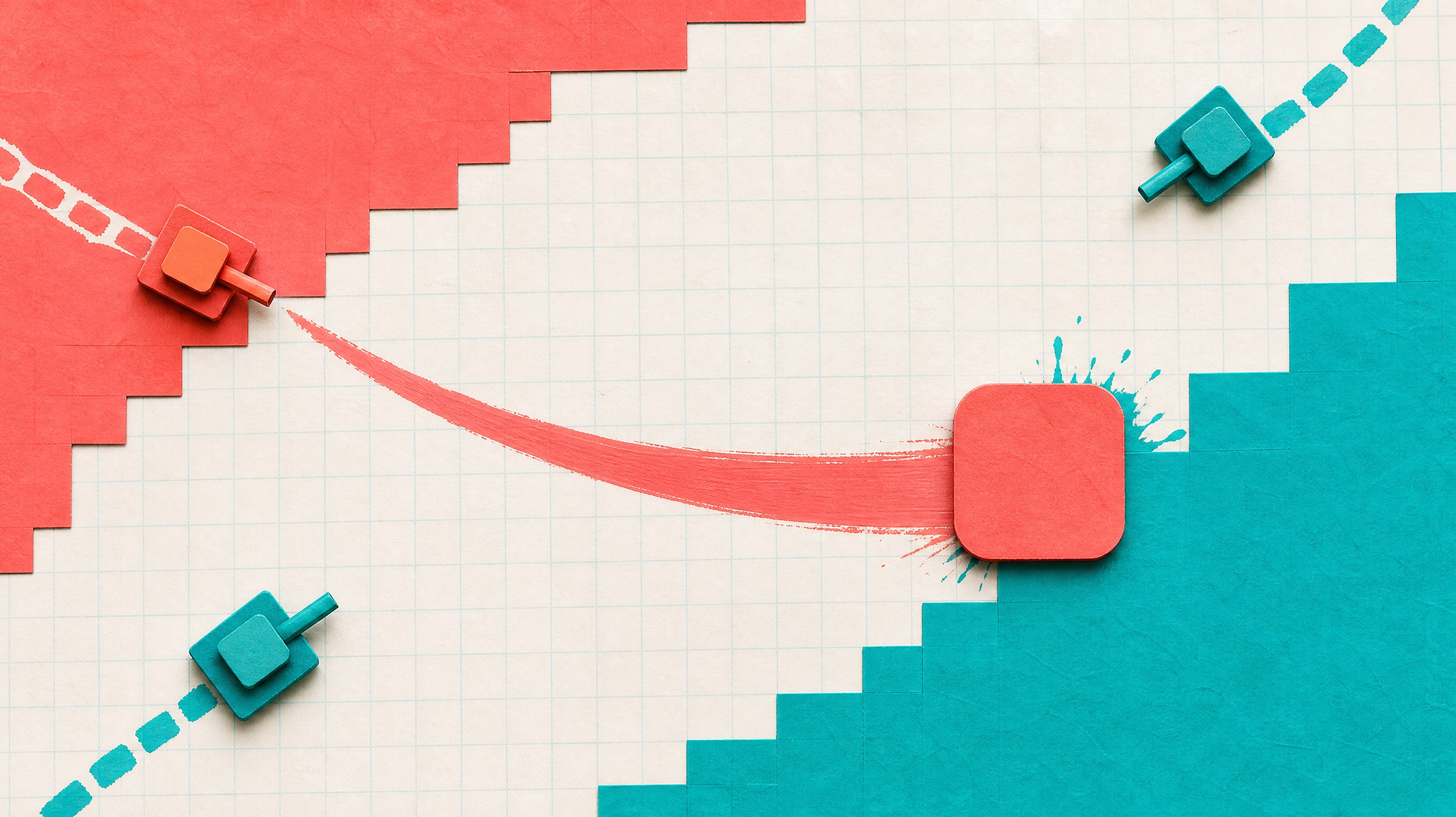
The onboarding is the design, and it's the part other .io games copy badly. There's no tutorial. You drag, a line trails behind you, and the first time you reconnect that line to your own color, the ground inside it floods with paint. That flood is the whole reward system: no confetti, no score pop, just territory turning yours.
Most mobile games bury that under five popups. Paper.io 2 hands it over before you've decided to stay.
The second lesson lands even faster. It's fear. The moment you cross your own border, the line behind you is exposed, and the game makes no effort to hide it. You can see the trap you're walking into. That's rare in a free-to-play game, and the loop needs it.
The Paper.io 2 Territory Math Behind Big Loops
The board shows your share as a percentage, which makes expansion look like a simple sum. It isn't.
Every loop you close gives you the ground inside it. A modest loop tucked against your own border is nearly free: your line stays short, you're seconds from safety, and the new edge joins your frontier, so the next loop starts further out. Ten loops later you've grown without ever being far from home.
The board keeps offering a better-looking trade. One huge sweep around the middle can add double digits in a single move, and it's the kind of clip people post. It also leaves a thin line across open ground for the whole trip out and back. Area scales with the square of the loop. Exposure scales with the perimeter and the clock.
Players on the game's subreddit have a rough rule: once a sweep runs past twenty seconds, somebody is already moving toward your line. I find that generous. Four or five seconds of unprotected travel is enough for a rival to change course.
The math looks stranger from the other side. Cutting someone costs you nothing but the trip, and when their trail breaks, their color vanishes and leaves white space anyone can claim. Hunting often beats expanding, which is an odd thing for a painting game to admit.
Three Ways You Die in Paper.io 2, and Who's Doing the Killing
Deaths here are cheap. They're also instructive.
The long sweep
You commit to a loop that wraps half the arena. Two thirds of the way around, a rival you never saw crosses your line, and you watch the rest of the trip happen without you. The rival wasn't the mistake. Betting the whole run on one number was.
Your own line
This death needs no opponent at all, which is what stings. Turn too tightly at the end of a loop, cut the corner where your trail is still wet, and the game ends you on the spot. Beginners do it right after a big capture, when the adrenaline says push and the geometry says no.
The camper at the border
Some players park along your edge and wait. Players call them snakes, and the name fits. The second you commit, they move for your line. If the cut lands within sight of home, you get a fraction of a second to touch your own color. Panic loses that window for you.
Not every death is geometry. On a mid-range Android phone, the drag-to-turn lags behind your thumb enough to feel, and in a game decided by fractions of a second, that lag kills runs. A 148Apps review made the same complaint, pairing lag with intrusive ads.
The multiplayer question is where the game gets slippery. Google's own listing files Paper.io 2 under Single player, the marketing sells online multiplayer, and the subreddit has argued for years that the arena is mostly bots. Recent Play Store reviews describe the AI reaching a trail it had no business reaching.
Reading an opponent only pays off when the opponent has habits. A bot has parameters, and parameters don't bluff. For five minutes that's an acceptable trade. For a competitive game it's fatal, and it's why I don't take the leaderboard seriously.
Paper.io 2 vs Splix.io and Snake.io
Neither comparison takes long.
Splix.io runs the same rule on a browser canvas: leave your block, draw a line, close the loop. It's uglier than Paper.io 2, and it puts far less between you and the game. No skin shop, no interstitials, no dashboard. If you want a free territory game with nothing attached, it's the cleaner way in.
Snake.io changes the bet. You grow by eating things, and a collision costs length rather than the entire run. It's the friendlier pick for a commute, and the less interesting one if sudden-death pressure is what you came for.
Paper.io 2 sits between them. Prettier than Splix.io, harsher than Snake.io, and wrapped in more monetization than either.
Ads, Skins, and What Paper.io 2 Charges You
The download is free, and the game is fairly open about wanting something back.
Ads are the first bill. You'll see them between runs, and plenty of players report them landing mid-run, which turns a two-second death into a thirty-second wait.
Not ideal.
The Play Store listing shows 3.9 from 2.21 million reviews, and the recent ones read like a tour of ad complaints.
The skin shop is the second bill. The listing advertises 100+ skins, daily free rewards and seasonal outfits, and none of it changes a rule. Same speed, same trail, same odds. If you need a reason to keep going, this is it. It's thin.
Paying deserves caution. Reports on the App Store and on review aggregators describe a one-time purchase that cleared the ads between runs but not every ad. One reviewer reported paying $2.99 and still getting a prompt to continue. Treat that as a pattern, not a guarantee.
A paid Steam build exists, DLC included, and its top reviews complain about repetition and a cursor that vanishes on multi-monitor setups. Skip it.
One more cost gets skipped. Google's data safety panel says the app may share location and app activity with third parties, and that the data isn't encrypted in transit. For a game about painting squares, that's a lot of paperwork.
Retention in Paper.io 2 After the Novelty Wears Off
Strip out the skins and one question is left: why play this next week?
Three things hold. The first is the 100% chase: the store promises a secret surprise for capturing the entire map, and players who've done it describe a slow grind from roughly a quarter of the board outward. The second is the leaderboard, which marks whoever is on top and turns the front of the table into a target. The third is the death loop. A run ends in two seconds, the restart button sits right there, and another attempt costs nothing except another ad.
That last one isn't retention in the usual sense. It's closer to a slot machine with better geometry, and it works on me more often than I'd like.
What doesn't hold is progress. No rank survives the session, and nothing records the good runs. Your fifteenth hour looks like your first, minus the novelty. After a week I play it the way I play a fidget toy: while waiting for something else.
If the loop is what you're after, it's one of the easier ideas to rebuild. On Binkbink you can describe an arena, a trail rule and a scoring bar in a prompt and get a playable version of the mechanic in a couple of minutes. What you get is a single-player toy, not netcode for a hundred strangers. We aren't affiliated with Voodoo, and nobody paid for this Paper.io 2 review.
The Verdict: Is Paper.io 2 Worth It?
Short answer: yes at five minutes a day, no at anything longer.
The loop is close to perfect. The shell around it isn't. Ads interrupt the one thing the game does well. Progression is cosmetic, and the opponent on the other side is probably code. None of that ruins a queue-length session. All of it ruins an evening.
Keep it if you want something for one thumb and five minutes, and you don't much care who's on the other side of the line. Skip it if you need progress you can point at, or if a mid-run ad makes you put the phone down.
Install the free version, ignore the shop, and hold off on paying until those ad reports settle. Play it in the gaps between other things, where a two-second death is funny instead of infuriating. The sixth minute is where it stops being generous. You can simply not give it one.