Space Waves Guide: When to Hold, When to Let Go
A Space Waves guide to hold length, release points and fast-section reads, plus a practice routine that turns crash percentages into a map.

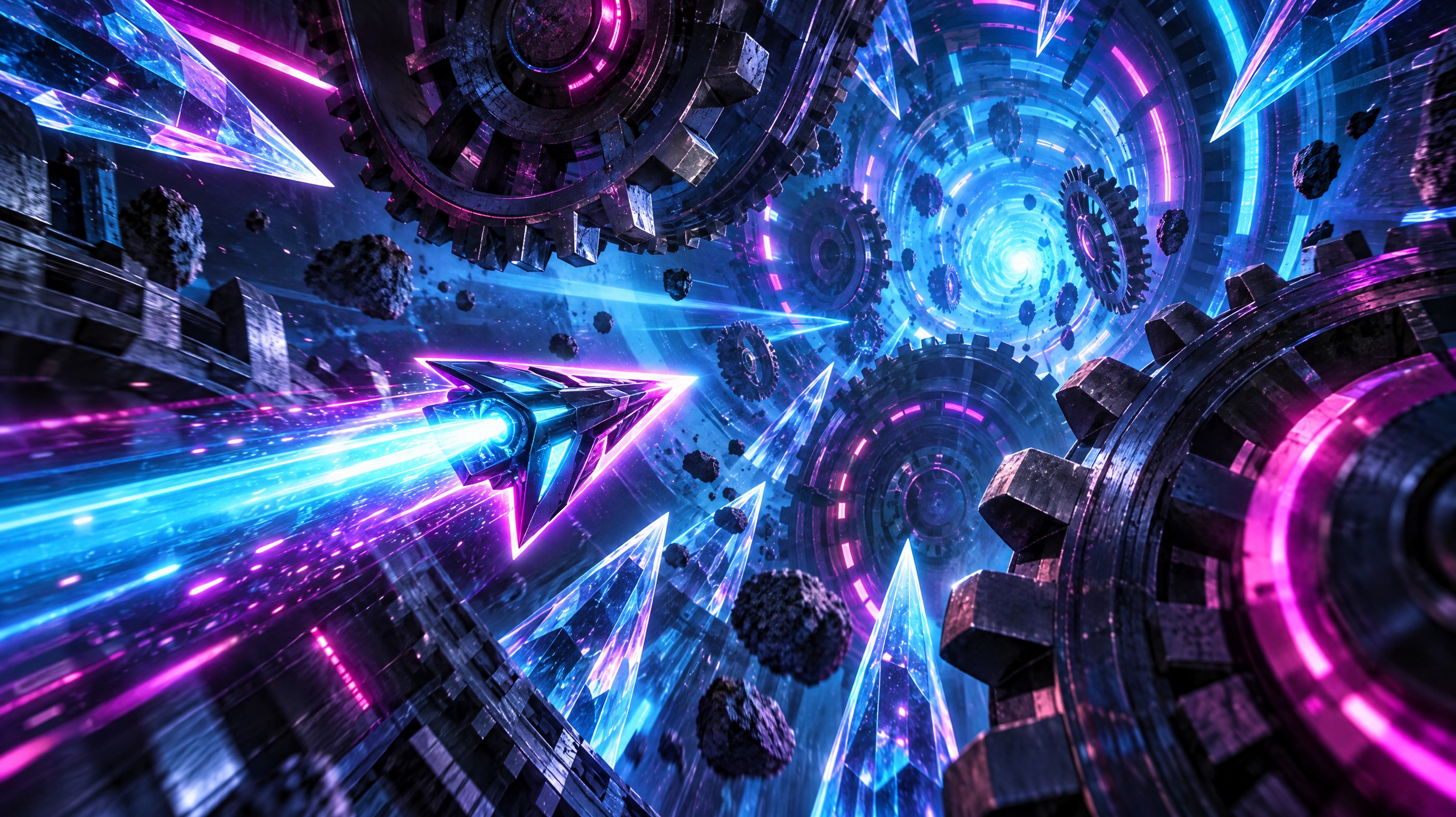
Space Waves gives you one input and no undo. Hold to rise, release to fall, and the arrow keeps moving forward, ready or not. Most crashes don't come from a gap that was too small. They come from a hold that started a beat late or ran a beat long, which is the same mistake wearing two different hats.
This Space Waves guide is about that beat. How long to press, where to let go, and how to keep reading the level when the speed climbs and your hands start voting for panic.
A quick note on what the game is. Space Waves is a one-button arcade game from do.games, live since April 2024, with dozens of levels spread across three worlds and a difficulty rating shown as faces before you start. It isn't ours and we've no affiliation with the studio. We just play it a lot, and the same three mistakes end runs at every difficulty tier.
Why Every Hold in Space Waves Is a Commitment
The arrow moves on a fixed diagonal: press and it climbs that diagonal, let go and it drops along the same line. The control scheme is hold to rise release to fall, and there's no modifier key, no brake, and no second button to save you. Your only real choice is duration.
That changes the question you should be asking. New players ask "should I press now?" Better players ask "how much height do I need before the next decision point?" Those sound similar. They lead to different hands.
Because the angle is fixed, a hold is a purchase. You buy altitude at a steady rate and you pay for it in horizontal distance. Commit to a long hold and you've spent the room you needed for the gap after the gap you were aiming at. That's the commitment problem in one sentence, and it explains why so many crashes happen one obstacle past the one you were watching.
Spend two seconds climbing toward a ceiling you didn't need and you've also spent the forward travel that would have carried you through the next two gaps. No amount of tapping buys that distance back.
Height is also a budget you can't refill by waiting. Coasting only takes you down. Nothing in the game gives altitude back except another press, and that press has a short delay before you see the climb. So if you're low and the next gap is high, you're already late. CrazyGames' own how-to-play notes put it plainly: start the move early, because the rise takes a moment to register.
Hold Length in Space Waves: Tap, Beat, or Long Press
Three durations cover almost everything. A tap is one short step, useful for micro-corrections and for corridors where the ceiling and floor are both close. A beat is a deliberate climb of roughly one gap's height. A long press is the rare case where the ceiling is far away and you need to cross a tall wall.
Most players only own two of those: tap, and hold-until-scared. The middle one is what wins levels. That's the habit this Space Waves guide keeps coming back to.
Here are the Space Waves tips that fix it fastest, starting with the one rule worth taping to your monitor. Hold for the gap you can see, not the gap you hope for. If the opening sits three arrow-heights up, beat your way to two and a half and let go. You arrive still climbing slightly, so the press is spent by the time the gap reaches you and there's nothing left to misjudge. Overshoot, and you clip the top edge.
In the tightest sections, steady tapping is the rhythm the game rewards. CrazyGames' tips say the same thing: when you're caught between obstacles above and below, tap continuously so the arrow zigzags through with forward momentum, instead of one heroic climb followed by a long fall.
Where to Release in Space Waves: Aim for the Lower Third
Release is steering, not surrender. It's the input that decides your descent, and it's the only one that costs you nothing in reaction time.
That asymmetry matters. Rising depends on a press registering, so a correction upward always lands a few frames after you wanted it. Falling starts the instant you let go. Given that, aim to enter gaps in their lower third rather than dead center. A low entry leaves the top half of the opening as reserve, and reserve is what saves you when the next obstacle shows up sooner than the rhythm suggested.
A low entry also means your next correction goes up into open space, instead of down toward a floor you won't see until the last half-second before it matters.
Center entry feels safer. It isn't. It leaves you one mistake from the ceiling in either direction, and it hides how little margin you had.
Circular spikes and rotating cogs deserve their own habit. Don't climb over them. Stay low and pass underneath, because going over means a long hold, a high entry, and a blind drop on the far side.
Reading Space Waves at High Speed: Two Gaps Ahead
Nothing about your input gets faster as the game speeds up. The arrow still climbs at the same rate, the delay before the climb still exists, and your hand still moves at human speed. What shrinks is the window in which each decision has to be made.
So at speed, your eyes need a lead. Stop tracking the arrow. Park your attention on a fixed point in the right-hand third of the screen and read the level as it arrives there. The arrow lives in peripheral vision, where it belongs, because you already know roughly where it sits: three arrow-heights below whatever you last committed to.
The other half is pre-commitment. By the time gap two reaches your fixed point, the input for gap one should be finished. If you're still holding when the next gap appears, you're reading with your hand instead of your eyes, and that's when the panic taps start.
Watch for the moment the pattern changes, too. Levels tend to run in phrases of a few seconds: a climb, a run of taps, a drop. A phrase is short enough to hold in working memory, maybe three or four seconds of climb, taps, and drop, and that's exactly the unit you should memorize instead of individual obstacle positions. Learn the phrase, not the frame. Memorizing single obstacles at two hundred attempts each is how people spend a week on one level and still can't replay it a month later.
Endless mode is the honest test. Its speed ramp means the hold that felt right at the start will be too long by the time the music doubles up. Players who look stuck on a level are usually not reacting badly. They're reading a phrase they half-remember at a speed their hands never practiced at. Recalibrate instead of assuming the game cheated you.
Three Habits That End Most Space Waves Runs
Panic tapping is the big one. It feels like control. In practice, each tap stacks height you didn't plan for, and you reach the next gap too high with the button already down. The fix is boring: pick a tap rhythm and keep it, even when the obstacle looks close.
Holding through the gap comes second. Players press to clear an obstacle, then keep the button down until they feel safe, which means they enter the opening still climbing. Release before the gap, not inside it, and the arrow drops into place.
Third is watching the arrow instead of the level. That habit is natural, because the arrow is bright and moving and your eyes like moving things. It also guarantees you react after obstacles have already arrived. Move your gaze forward by one gap and let the first hour feel wrong.
Same fix for all three.
There's a fourth one that's less about skill: full restarts. Crash at seventy percent and start over, and you spend the next attempt re-playing the easy part. Practice mode exists so you don't have to.
A Practice Routine for Space Waves Timing
This is the part most guides skip, and it's the part that changes your hands.
- Pick a level one difficulty face above comfortable. Green levels have wider corridors and gentler angles, which is fine for learning the rhythm and too forgiving for timing work.
- Open practice mode from the level screen and place a checkpoint just before the section that keeps killing you, not at the start of the level.
- Run that section five times without leaving it. Three clean passes in a row is the signal to push the checkpoint forward, not a reason to quit while ahead.
- Name the phrase out loud as you play it: climb, tap, tap, drop. Naming turns a reaction into a plan, and plans survive speed increases.
- Take the full run once you clear the section three times out of five, not before. Expect the first full attempt to fail anyway. The checkpoint taught your hands the pattern, and the full run teaches your eyes the transition into it.
- Finish each session with ten minutes of Endless. It's the cheapest way to practice reading at a speed you didn't pick.
One practical note on the crash screen. It hands you a percentage, and sometimes an offer to resume from that point. Read the percentage as a map of where your reading breaks down. Dying at the same number four times in a row isn't luck and it isn't the game being unfair, it's a specific phrase you haven't learned yet.
Space Waves FAQ
Does holding longer make the arrow rise faster? No. The climb angle is fixed. Hold length changes how far you go up, not how quickly, which is why long presses are a precision tool rather than a power move.
Is Space Waves the same as Geometry Dash? They share the wave-style zigzag, and CrazyGames' own FAQ calls them very similar. Space Waves drops gravity flips and speed portals and keeps a constant forward speed, so the skill sits almost entirely in duration control.
How do I beat a level I keep dying on at eighty percent? Practice the last fifth on its own with a checkpoint, get three clean passes, then run the whole level. Repeating the full attempt trains the easy eighty percent and almost none of the part that's failing.
The hold is the whole game. Get the duration right and a level turns into a rhythm you can hum. Get it wrong and every gap looks like a trap. Pick one level, put a checkpoint in front of the section you hate, and run it five times before your next full attempt. If you'd rather build a one-button arcade game than beat one, our create page takes a plain-language description and returns something playable, which is a quick way to learn how much timing design sits inside a game this simple.