Games Like Wordle That Survive Past Week One
Seven games like Wordle, compared by mechanic, difficulty and daily rhythm, plus how to pick one that lasts past the first week.

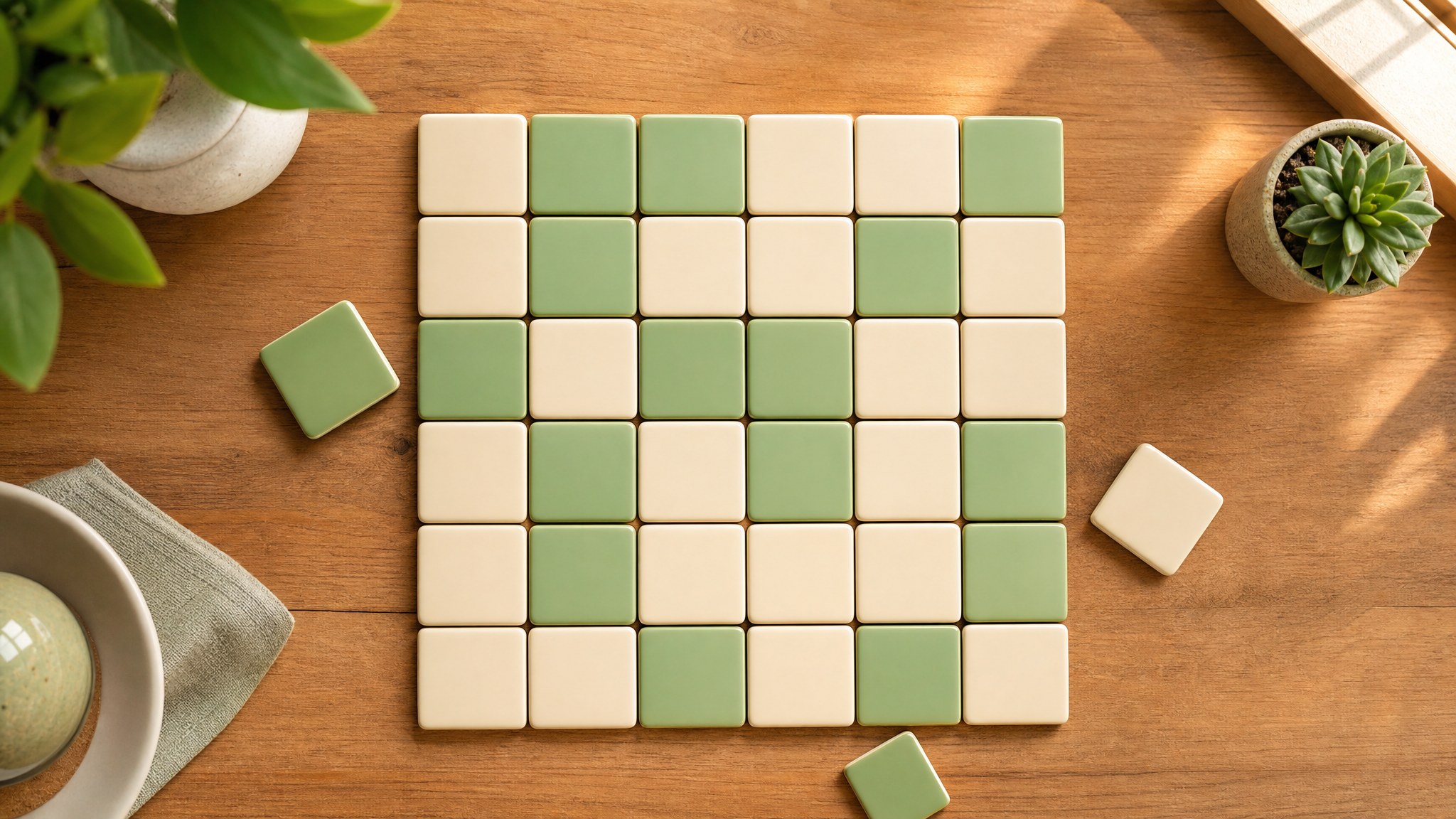
Most new daily puzzles get about a week. Two days of novelty, three days of routine, then the tab stays open and you click it out of politeness. The games like Wordle that stick around protect the single daily attempt instead of adding boards and timers to look generous.
We compared seven over a week. Each entry turns on a different question, from letter economy to what happens when two people play at once. All seven are free in a browser, unaffiliated with Wordle or the Times.
The seven games like Wordle at a glance
Game | What you do each day | Session | Difficulty | Best for |
|---|---|---|---|---|
Quordle | Four words, nine guesses | 4-6 min | Hard | Word-game veterans |
Connections | Sort 16 words into four groups | 2-4 min | Moderate | Anyone tired of letter grids |
Strands | Find themed words in a grid | 3-6 min | Gentle to moderate | Word-search fans |
Waffle | Swap letters into six words | 3-5 min | Moderate | Spatial thinkers |
Squabble | Race others to the same word | 5-10 min | Hard | Group players |
Semantle | Guess a word by meaning, not spelling | 10+ min | Punishing | Language obsessives |
Worldle | Identify a country from its outline | 2-3 min | Moderate | Map people |
Why most games like Wordle die in a week
Wordle hands out one puzzle a day, six guesses, and an answer that everyone else is chasing at the same hour. Take away any of those and the ritual thins into a game. A clone with unlimited puzzles is a fine way to kill ten minutes. It isn't a habit.
The share grid does more work than it gets credit for. A row of colored squares tells your group chat that you played, how badly, and nothing about the answer. That's a social object, and most Wordle alternatives never build one.
Quordle: one keyboard, four boards, nine guesses
Nine guesses for four words sounds generous until the first letter lands on all four boards. Quordle shares one keyboard across four grids, so every guess is a purchase in four markets. A green up top can come back gray below.
That makes it a budgeting game. You spend rare letters where they pay off and accept that one board will finish late. Merriam-Webster bought Quordle in January 2023, after it became a daily stop for people who found Wordle too short (reported by the BBC and TechCrunch).
The weak spot is the finish. With two boards left and three guesses, solving feels like arithmetic rather than vocabulary.
Connections asks you to stop spelling and start sorting
The board looks easy for eight seconds. Then you notice that five of the sixteen words could belong together, and that the game allows only four mistakes before it ends your day.
Connections is the cleanest break from the formula here. No letters, no keyboard, just sixteen words and four hidden categories. The color tiers show how the puzzle is built: yellow is literal, green is a step sideways, blue wants outside knowledge, purple runs on wordplay. Difficulty lives inside a single board, not across a week.
It also fails differently. You don't lose because you don't know a word. You lose because you were sure.
Strands pays you in hints for poking around
You drag a finger across letters, which makes Strands feel closer to doodling than solving. The grid holds a set of theme words plus one spangram, a word that runs edge to edge and states the theme.
The hint economy is the interesting part. Every three non-theme words earn one hint, so flailing is productive. A bad guess in Wordle costs you a row and teaches you almost nothing about the answer. Strands rewards the same curiosity most daily word games punish.
The catch is length: once the theme clicks, the grid collapses in about a minute, and the spangram tends to be the last thing you spot.
Waffle is a routing problem disguised as a word game
Every letter you need is already on the board. Waffle deals a five-by-five grid that should hold six words, three across and three down, then scrambles the letters in place. You get 15 swaps to fix them.
So the puzzle isn't vocabulary. It's sequencing. You can read all six answers at a glance and still run out of swaps because you moved one letter twice. That's the rarest kind of difficulty among these daily word games: knowledge isn't the bottleneck, planning is.
The shape repeats daily, so the curve stays flat. Learn to fix the corners first and most boards fall in ten swaps, which makes Waffle the most reliable five minutes.
Squabble turns the daily ritual into a 99-player race
The daily format has one flaw. It's a solo habit in a multiplayer world. Squabble puts a timer and a lobby around the same guessing rules.
Developer Ottomated built two modes. Blitz runs with two to five players, and Squabble Royale takes six to ninety-nine. You watch opponents' progress bars fill while you're still on your second guess, which turns a calm morning puzzle into something closer to a bar bet and makes speed part of the solving. Safe openers stop making sense.
It's the only entry here that needs other people. Without a lobby there's nothing to play, and a shaky connection costs you a round.
Not ideal before coffee.
Semantle grades meaning, which is a different kind of hard
Your first guess will be wrong, and Semantle will tell you exactly how wrong. It scores semantic similarity with a Word2vec model trained on Google News text, which means "ocean" lands close to "sea" and nowhere near "oven".
There's no letter feedback at all. You build a map of meaning from ranks, and the early guesses feel random because they're random. Two costs come with it: the model is English-only, and a bad opener can eat ten minutes before you have any traction.
Then a jump from 340th place to 19th tells you that you're circling the right idea, and the last twenty guesses are the most fun you'll have all morning.
Worldle moves the puzzle from letters to borders
A silhouette, six guesses, and a compass. Worldle shows the outline of a country and grades each guess with distance, direction, and a proximity percentage. The feedback is spatial, so the puzzle runs on map memory rather than language.
That makes it the best change of muscle in this list. After a week of five-letter words, naming a country from its coastline feels like a different hobby. The arrow does most of the work once you're on the right continent, and small island nations remain a coin flip, at least for me.
Which of these games like Wordle fits your morning
So which one deserves the slot? If six rows feel too short, Quordle is the direct upgrade. If you want to stop typing letters altogether, Connections is the cleanest switch. Fidgeters tend to prefer Strands or Waffle. Anyone with a group chat should try Squabble.
Language matters more than most lists admit. Every game here is English-first, and Semantle's model is built on English news text, so players who want daily word games in Spanish, Japanese, or Portuguese have far fewer options. That gap is part of why we built a puzzle maker.
Build your own daily puzzle instead
We make Binkbink, an AI game maker, and a puzzle is easy to describe: a grid, a guess limit, a theme, and a share line for the group chat. The AI handles the game logic and the art, and you get something playable without writing code.
Be realistic about limits. A generated puzzle won't match the polish of a hand-tuned daily game, and it shouldn't try to copy Wordle. The word list and the difficulty curve still need a human pass, because a puzzle that's too easy dies faster than one that's too hard.
- Open the Puzzle Game Maker at binkbink.ai/create.
- Describe the loop in one paragraph: how many letters, how many guesses, what a wrong guess tells you.
- Play it three times and cut the words that make the first guess too easy.
- Publish, then send the link to five people and watch where they get stuck.
That fourth step is the real test.
If you've already tried games similar to Wordle and bounced off the harder ones, start with Strands or Worldle, since both forgive a slow opening. Then give the winner a full week and notice why you open it: the puzzle, or the streak. That answer tells you more than any list can.